
Raúl Carrillo
Texas A&M University
Volume 18, 2026
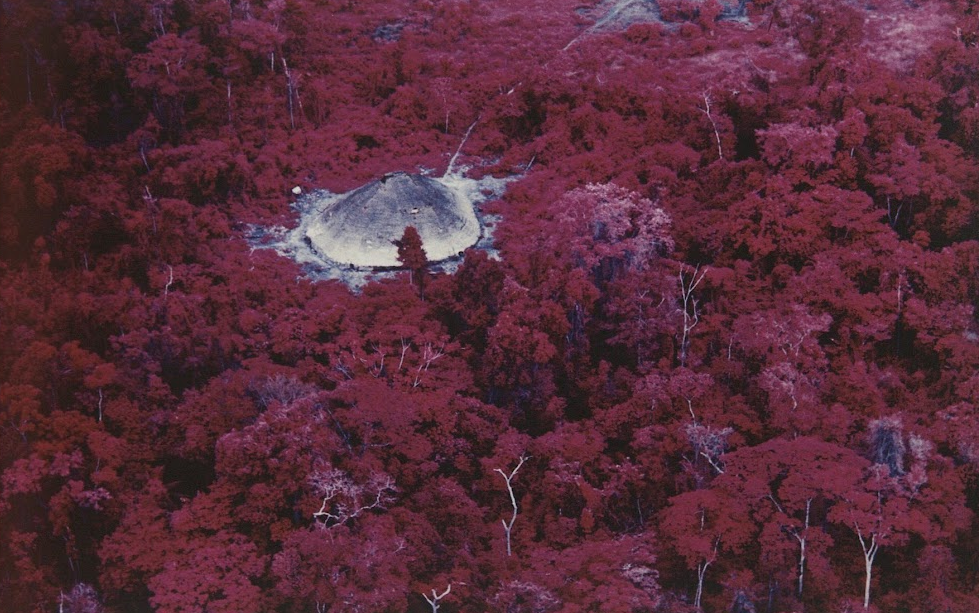
The Yanomami are one of the last remaining Amerindian ethnic groups living deep in the Amazon forest. They divide themselves in autonomous groups which are nonetheless constantly interacting with each other in situations of hospitality and hostility. The people of each group live together in cone-shaped collective houses, called yanos or shabonos, and they hunt and garden in the adjacent forest (see fig. 1). Davi Kopenawa was born around 1956 in one such house, Marakana, located at the foothills along the upper Toototobi River in the far northeast part of the state of Amazonas in Brazil, near the border with Venezuela. In the late 1970s, he relocated to the communal house of his in-laws, Watoriki, meaning “Wind Mountain,” where he was initiated into shamanism by his father-in-law, Lourival, at the age of 27 years old. Claudia Andujar was born in Neuchatel, Switzerland in 1931, but lived her childhood in Oradea, Romania. In the mid 1940s she fled back to Switzerland, and then to New York, to escape persecution during the Second World War. In 1955, she arrived in São Paulo, Brazil—the city in which she still lives, and where she made her career as a photographer. The first time that Andujar photographed the Yanomami was in 1971 for a special issue of the Brazilian magazine Realidade (1966-1976). Later that year, and once again in 1977, Andujar was the recipient of two John Simon Guggenheim Foundation grants which allowed her to do extensive photographic and humanitarian work with the Yanomami. Andujar and Kopenawa met for the first time in 1977, near Lobo d’Almada River, as they were both treating the survivors of a measles outbreak in the region. The following year, Andujar co-founded the Commission for the Establishment of Yanomami Park (CCPY), and, in company with Kopenawa, fought for the legal recognition and protection of Yanomami territory. More than a decade later, in 1992, on the eve of the Rio Earth Summit, the commission accomplished its main objective—to have the Brazilian government ratify 9,419,108 hectares in the states of Roraima and Amazonas as Yanomami Indigenous Territory.
Previous commentators have certainly interpreted Andujar’s photography in relation to the Yanomami—for example, as a visual interpretation of their culture, or as tools in the appeal for their human rights. However, an exclusive focus on the visual and political (here understood in terms of rights) risks missing an essential aspect of Andujar’s photography and Kopenawa’s testimony—namely, the experience of the “shamanic spirits” in dreams, hallucinations, and photographs. Andujar’s photography in relation to Kopenawa’s testimony calls for an analysis of the structural limits of the concept and experience of hospitality and the other as foreigner, as theorized by Jacques Derrida. On the one hand, Andujar’s and Kopenawa’s work moves within the classical delimitation of the meaning of hospitality and the foreigner, that is, one anchored in the concepts of the human, territory, and human rights. On the other hand, Andujar’s photography and Kopenawa’s shamanism question the limits of an experience of hospitality centered in the properly human and politics defined in terms of human rights. Both, the shamanic spirits and the photographs play with the differences between the visible and the invisible, the present and the absent, the guest and the host, etc., and open the door to an experience of hospitality beyond the human. Read in company with Derrida, Andujar’s photographs and Kopenawa’s testimony of the shamanic spirits are salient examples of the experience of the arrival of the other as non-human at the limits of hospitality.
According to Derrida, at least since Kant, the experience of hospitality has been rigorously delimited by being codified in terms of human rights. In Toward Perpetual Peace, more precisely, in the article titled “Third Definitive Article of Perpetual Peace: Cosmopolitan Right Shall be Limited to the Conditions of Universal Hospitality,” Kant wrote: “As in the previous articles, we are concerned here with right, not with philanthropy, and in this context hospitality (a host’s conduct to his guest) means the right of a stranger not to be treated in a hostile manner by another upon his arrival on the other’s territory.” (82) Universal hospitality does not arise from philanthropy, namely, the love of humanity as a sentimental motive, but from a right and a duty regulated by international law. This is not the right of the stranger or foreigner to settle or reside in the host’s domain, but the right to visit—at least on the condition that the guest behaves peaceably. The respect and enforcement of this right is a condition to bring humanity closer to a cosmopolitan constitution and perpetual peace because it guarantees the possibility that remote parts of the world establish relations with one another in the form of commerce.
In the inscription of the experience of hospitality in the sphere of rights and international law, Derrida identified an instance of the self-contradictory logic of hospitality. As he put it, there is “a law of hospitality that violently imprints a contradiction on the very concept of hospitality by setting limits on it,” which can be formalized in the following way:
Hospitality, that’s good, we need it, it’s a right, a duty, and obligation, a law, it is the welcoming of the foreign other as friend but on the condition that the host, the Wirt, the one who receives or shelters or offers asylum, remain the proprietor, the master of the house […] and hence, limits the gift offered and makes of this limitation, that is, of the being-oneself at home, the condition of the gift and of hospitality. (Derrida 4-5)
Hospitality only happens on the condition that the host guards the authority of the self at-home, namely, that he (traditionally the paterfamilias) affirms the identity, truth, and power of the law of his household, property, nation, etc. This affirmation of the laws of the host cannot but limit the hospitality and the welcome offered to the guest. These limitations in the form of norms, rules, and laws of hospitality—cultural, ethical, political—are not simply external or contingent difficulties, but are the conditions without which no hospitality would be possible. Yet, every situation of hospitality worthy of the name must be unconditional. Unconditional hospitality is an affirmation of the other; it is offered without or beyond questions—for example, without asking for a proper name or a passport. It commands beyond duty, and exceeds the sphere of rights and law. For Derrida, there is an antinomy between the single law of hospitality that commands unconditionally, and the multiplicity of laws—ethical, political, cultural—in which it is instantiated. For example, the enforcement of the laws of a nation-state, which every right presupposes, cannot but limit and condition the experience of hospitality itself by excluding those who cannot appear in the mode of objectivity required by the law. Then, hospitality is a “contradictory concept and experience, one that cannot but self-destruct or protect itself from itself…precisely…by exercising itself.” (Derrida 5) The experience and concept of hospitality carries within itself its own hostility in the form of the necessary affirmation of mastery of the host which in turn limits the arrival or visitation of the guest.
The same philosophical tradition which has determined the strict sense or proper meaning of hospitality has also attempted to delimit the arrival of the foreigner (étranger) by inscribing both of them in the “triple ipsiety of family, civil society, and the nation-state.” (Derrida 63) For example, hospitality and the foreigner have been theorized in relation to the household, personal property, and citizenship. The foreigner is not the human other in general, but one with a valid visa and passport. Properly speaking only human beings can be foreigners and be granted hospitality. As a consequence of this delimitation, the “ordinary” meaning of hospitality and foreigner would inscribe them “within the limits of a determination of the limit,” which would keep us from considering all the “turbulence, semantic or pre- or ultra-semantic” that blurs such limits. (Derrida 63) This turbulent movement tends to exceed the juridical codes in which the proper meanings are inscribed. The root of the problem, or the eye of this “maelstrom” of ipsiety, is that “the foreigner is never present or presentable as such.” (66) The foreigner does not appear as such; indeed, it is defined by its non-appearance. It evades phenomenological intuition and its mode of appropriation. Moreover, this turbulent movement of the meaning of hospitality and foreigner would not be the effect of a philosophical critique of right, but “the effect of the fact of effectivity”—for example, the effect of the “tele-techno-scientific powers” of information and the market which “overflow both the state’s authority and status…” and are sometimes referred to as “globalization.” (67) The meaning of hospitality and foreigner are cracked open by the currents of this maelstrom, and carried beyond their conventional limitation to the properly human and a politics centered on rights.
Anti-Extractivism in Yanomami Territory
Andujar’s photography, and Kopenawa’s testimony conjure the violent history of the encounter between the Yanomami and outsiders. Many commentators have interpreted the work and thought of both Andujar and Kopenawa from an explicitly political angle, namely, one that is anchored in the concepts of human rights, territory, and the nation-state. Bonchristiano, for example, argued that “both Andujar and the Yanomami, through their relationship with light, have communicated Yanomami traditions and cosmovision to a non-Indigenous audience and given the Yanomami a vital tool in the appeal for their rights.” (569) This is certainly not incorrect, and deserves to be explored in greater detail. Andujar and Kopenawa resisted the developmentalist, extractivist, and genocidal ideologies of the Brazilian government that arose soon after the first contacts with the Yanomami. We could date the origin of these policies back to the 1950s, although they belong to a longer history of colonization in Latin America which continues to the present. This is a history of hostility; not only of the both brutal (massacres) and unintended (epidemics) hostility of the foreigners toward the Yanomami and the forest, but also the hostility of a tradition that attempts to restrict the encounter with the foreign other to a situation of hospitality delimited only within the sphere of rights. The sphere of rights is not broad enough to encounter the foreigner as foreign. This is because the foreigner arrives in a mode of non-appearance that cannot be mastered by the law. At best, it can affirm the notion of territory, but this misses essential aspects of their experience—in particular, the way in which the Yanomami relate to the forest and welcome the living and non-living beings that dwell in it.
The first photographs that Andujar took of the Yanomami appeared in the context of a criticism of the projects of development and colonization of the Amazon by the Brazilian government at that time. In 1970, the military dictatorship of General Emílio Garrastazu Médici (1969-1974) launched the “National Integration Plan” which “entailed thousands of kilometers of highway, creation of hundreds of cattle ranches, and a large-scale public project of regional colonization based on migration of colonists from northeastern Brazil who would receive land at the edge of the highways.” (Nogueira 167) The following year, the Brazilian photo-journalistic magazine Realidade (1966-1976) launched a large scale operation, in which Andujar participated, with the objective of examining the Amazonian territory of Brazil, and to report on the current status of the government’s plans to colonize and exploit the region’s potential. Although, as Andujar mentioned, “they asked me not to photograph the indigenous people,” she found an excuse to go up the Rio Negro to photograph the Yanomami. (Nogueira, “In Conversation” 120) Nogueira described the photographs that appeared in this volume as “tender,” potentially “idealizing,” and aimed at eliciting the “reader’s empathy.” (Yanomami Struggle 170) One of them appeared on the cover of that issue, while the rest accompanied the text of an unsigned article titled “The last chance of the last warriors”.1 These photographs and the article are an early example of a photo-journalistic style which Andujar abandoned later in her career.
In 1974, Andujar traveled to the Catholic mission of the Catrimani River, in the state of Roraima in northern Brazil, to once again photograph the Yanomami. This time, funded by a Guggenheim grant, she was prepared to stay for two years with the Yanomami. During this time, she was able to witness and capture the pernicious effects of the assimilationist and extractivist policies of the Brazilian government in the region. On the same year that Andujar arrived to Yanomami territory, a new government initiative, the “Polamazonia Project,” now under the administration of General Ernesto Geisel (1974-1979), opened up the first fifty kilometers on both sides of the Perimetral Norte highway (BR-210) for agricultural colonization. According to Albert, “the presence of the road workers and, later, the influx of colonists along the highway caused an unprecedented epidemiological shock among the Yanomami population and led to significant demographic loses.” (Kopenawa and Albert 466) In Andujar’s own words: “I saw hundreds and hundreds of people dying. These people had no immunity to the diseases that were suddenly brought there. And, because of that I decided to dedicate my life to their lives and culture.” (Nogueira, “In Conversation” 120) Andujar photographed, for example, a worker who died during the construction of the highway, and a young Yanomami wearing a helmet property of the Camargo Corrêa construction company.
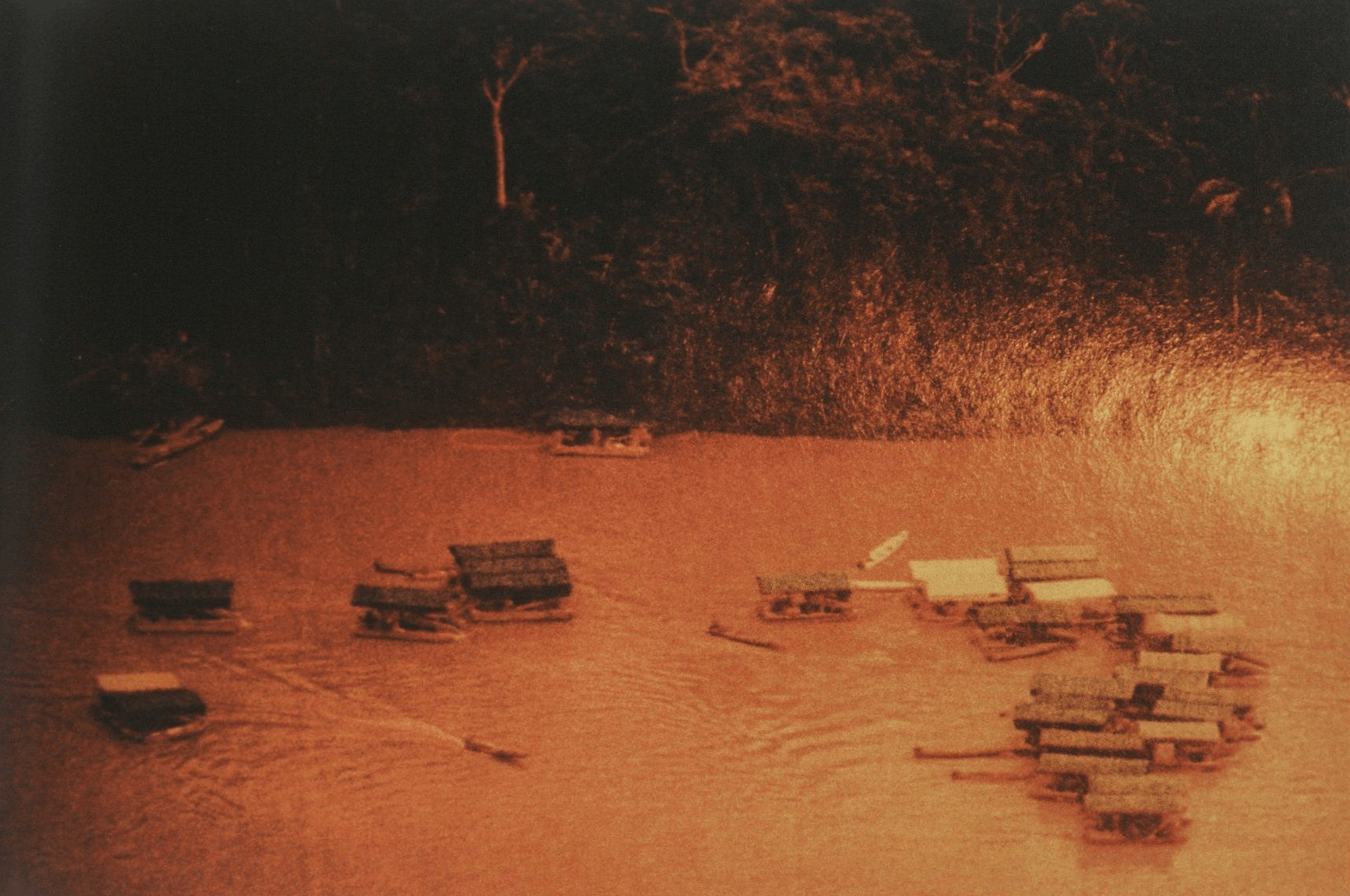
In the following decades, the situation of the Yanomami only worsened due to the legal and illegal mining projects in the region. Alongside the opening of the Perimetral Norte, the government launched the RADAM project to make a systematic inventory of the natural resources of the region. It employed Brazilian technicians trained by the Institute for Space Research and NASA in the use of a side-looking airborne radar (SLAR) for large-scale mapping of landscapes; it revealed the agricultural and mining potential of the Serra Parima. Soon after the report, in 1975, a first wave of illegal prospectors, known as garimpeiros (“wildcats”), arrived in the region in search of gold and other minerals. The frequency of the invasions and quantity of garimpeiros in Yanomami territory increased dramatically over the following decade. The official representatives of the states of Roraima and Amazonia often sided with the prospectors and mining companies, and even engaged in defamation campaigns against Andujar and her colleagues—who were expelled from the region in 1987 by Romero Jucá Filho, president of FUNAI from 1986-1988. He supported the miners, and, moreover, suspended the healthcare agreements with the CCPY. The suspension of the activities of the CCPY, the negligence of the federal government, and the pro-mining stance of state officials inaugurated a dramatic gold rush over the following years (see fig. 2). According to Albert, “this massive invasion inevitably led to catastrophic ecological and epidemiological consequences on a much larger scale than the one suffered during the 1970s period of highway construction and agricultural colonization.” (Kopenawa and Albert 467) It is estimated that nearly 13 percent of the population was decimated in just three years. The gold prospectors also systematically contaminated the upper streams of the main rivers of the region by discharging mercury, motor oil, and other mining refuse into them.
During these difficult decades, Andujar remained committed to the Yanomami cause. As head of the CCPY, she defended the forest against legal and illegal extractivist projects, and participated in health and immunization campaigns all across the region. As a photographer, she increasingly participated in projects that highlighted the deterioration of the living conditions of the Yanomami and publicized it. Nogueira put it in the following way: “She felt obligated to suspend her project on the visual interpretation of Yanomami culture and dedicate herself to images that would publicize their destruction—although throughout her career she had avoided photographing very ill people or funerals.” (Yanomami Struggle 236) Two of her projects from this period exemplify her concern for the survival of the Yanomami, and her support in their fight for the recognition of their rights: the first one, Povo da lua, povo da sangue (1984), is a twenty-seven minutes long film, directed by Marcello Tassara, which exhibited Andujar’s photographs in tabletop animation and arranged them to narrate the history of the Yanomami since the first contacts with outsiders.2 The film is also an excellent introduction to Andujar’s photographs from that period. The second one, of much more ambitious proportions, was the collaborative project titled Genocídio do Yanomami: morte do Brasil, which debuted in 1989 at the Museum of Art of São Paulo.3 In two acts—first one more didactic, then one more critical—the installation aimed at conveying the violent transformation of the world of the Yanomami caused by contact with Western civilization. “Slicing the photographs into strips, the predominance of yellow, and the spectral appearance of the images suggested isolation, the greed for gold, and the annihilation of the Yanomami,” according to Nogueira. (Yanomami Struggle 247) These two artistic projects demonstrate Andujar’s intention of making visible the Yanomami struggle to generate traction in favor of their cause.
Similar to Andujar, Kopenawa’s work and thought can be interpreted from the point of view of politics as a crucial component in the recognition of the rights of the Yanomami and their struggle for survival. Thanks, in part, to his friendship with Andujar, Kopenawa became acquainted with the legal and ecological discourses that activists in Brazil and overseas deployed to defend the Amazon forest. Nonetheless, according to Albert, it was his shamanism that allowed him to “elaborate a cosmological and political interpretation of the white world’s encroachment, one that proved very effective for defending Yanomami rights in general and his community’s rights in particular.” (Kopenawa and Albert 474) During the 1980s, Kopenawa, in company with his mentor and father-in-law, Lourival, a powerful shaman and great man (pata thë) of his community, engaged in multiple shamanic sessions to produce a series of statements against the gold prospectors, mining companies, and cattle ranchers that “were carried by all the major media in Brazil and internationally.” (475) These sessions culminated in a prophecy which posits that the continuation of the extractivist policies of the Brazilian government (and, in general, the world of the “whites,” or outsiders) will bring about the death of the shamans, and, consequentially, the catastrophic event of a new falling of the sky, akin to the one that happened at the beginning of time in Yanomami mythology. As mentioned before, the cooperation and resonance between Andujar’s photography and Kopenawa’s shamanism were crucial in the fight for the delimitation and protection of Yanomami territory. Although this was an important victory, it did not bring about an end to the struggle for the survival of the Yanomami and the Amazon forest.
Photography and the Limits of Hospitality
As mentioned in the previous section, Bonchristiano interpreted Andujar’s work in relation to the Yanomami as “a vital tool in the appeal for their rights.” (569) Similarly, Schefer argued that Andujar “used photography as an instrument for political change.” (341) The political interpretation of Andujar’s photography is not incorrect. However, Andujar’s photography in relation to Kopenawa’s testimony calls for a different interpretation and mode of analysis that questions the limits of the political—in this case defined in terms of the struggle for the recognition of the human rights of the Yanomami and the defense of their territory. An interpretation that stays within the limits of the political risks missing essential aspects of both Andujar’s photography and the experience of the Yanomami, namely, the arrival of the shamanic spirits in dreams, hallucinations, and photographs. Andujar’s photography and Kopenawa’s shamanism are experiences of the arrival of the foreign other in its foreignness at the limits of hospitality. They crack open the conventional meanings of hospitality and foreigner, and carry them beyond their delimitation in terms of human rights, territory, and the recognition of the nation-state. With respect to Andujar, no other period of her work exemplifies a situation of hospitality at the limit better than her trips to Yanomami territory near the Catrimani Mission during the 1970s. From this period, I will be focusing on two series of photographs: first, the photographs of the reahu ceremonies, and, second, a series of black and white portraits of the Yanomami people.
In 1974, funded by a Guggenheim grant, Andujar arrived at Yanomami territory located near the Catrimani Mission. According to Nogueira, during that time, “she plunged into the daily activities, embarked on long hunting expeditions, and took part in the many funeral feasts and commemoration of alliances between communities, known as reahu.” (Yanomami Struggle 174) The reahu is an intercommunal feast and funerary ceremony. As such, it is best understood as an experience of hospitality. In the conventional sense, every reahu is an experience of hospitality between human beings, but it is also the occasion for the arrival of non-human guests and non-living ancestors. Every reahu follows from an invitation song (hiimuu) of one group to another. (Kopenawa and Albert 505) On the eve of the reahu, guests are expected to camp one last night in the forest while the hosts intone joyful heri songs. (Kopenawa and Albert 505) The following day, the guest will perform a presentation dance (praiai) for their hosts. (Kopenawa and Albert 492) In turn, the hosts provide the maximum possible amount of food—boiled ripe plantain soup, peach palm fruit juice, and sweet manioc juice to their guests—it is considered impolite to decline the offering even if this leads to a feverish indigestion. (Kopenawa and Albert 511) The singing resumes at night; although, this time, both groups will be accompanying each other. (Kopenawa and Albert 500) Sometimes, hosts and guests form pairs and sing around the central plaza (hakimuu); young couples often take advantage of the dark to slip out of the house. (Kopenawa and Albert 513) Until dawn, hosts and guests engage in two types of ceremonial dialogues: one is conducted standing face-to-face, and is meant to convey community and intercommunity news (wayamuu); and the other is conducted squatting, it involves only the oldest man, and is meant to negotiate marriages, exchanges of goods, and manage intercommunal relations (yãimuu). In brief, I will say more about the shamanistic and funerary aspects of this ceremony, and how they question the conventional limits of hospitality.
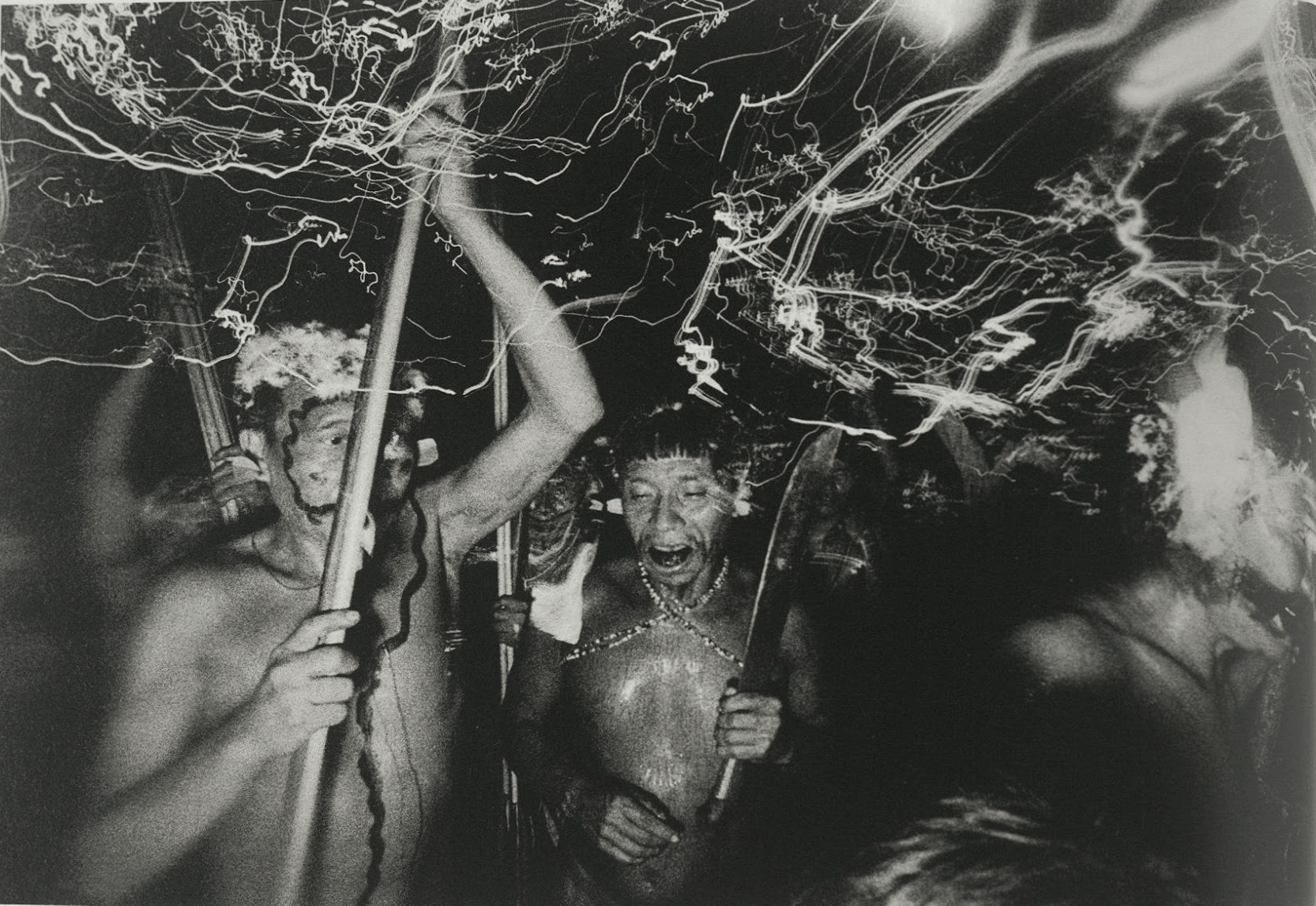
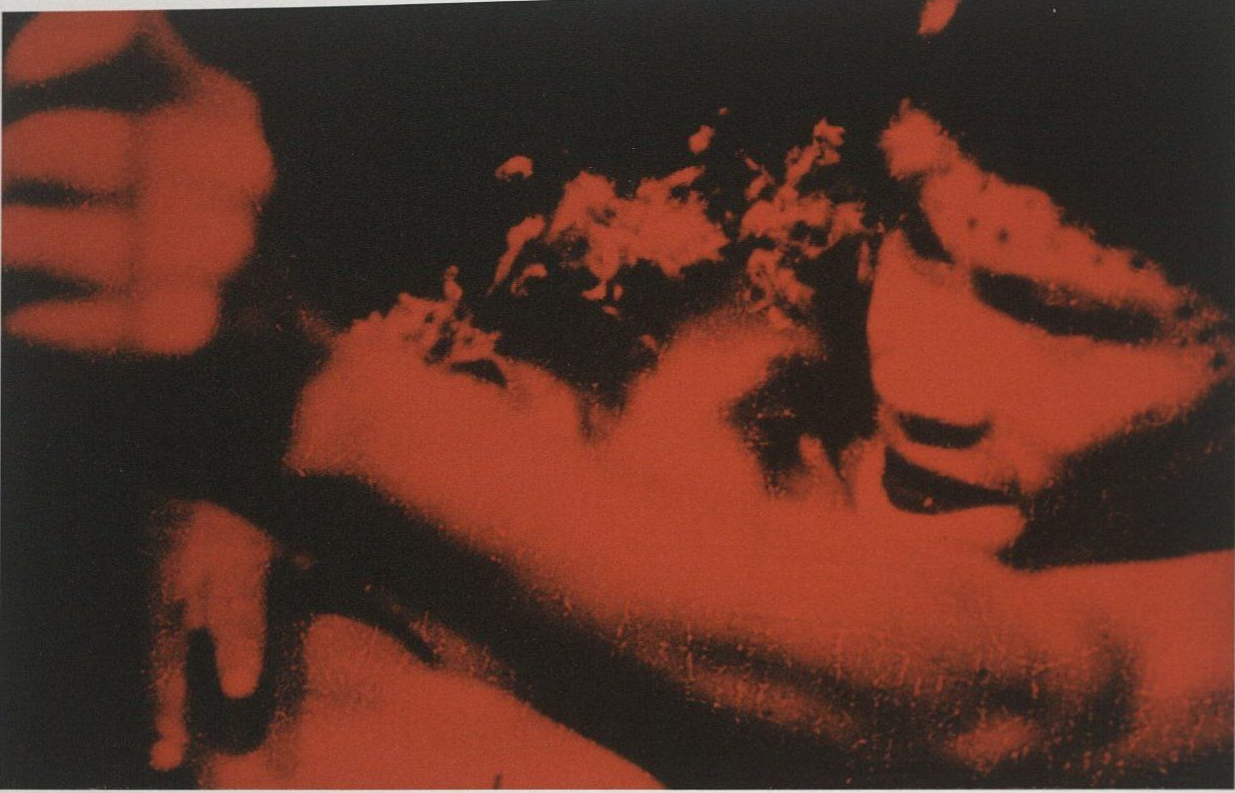
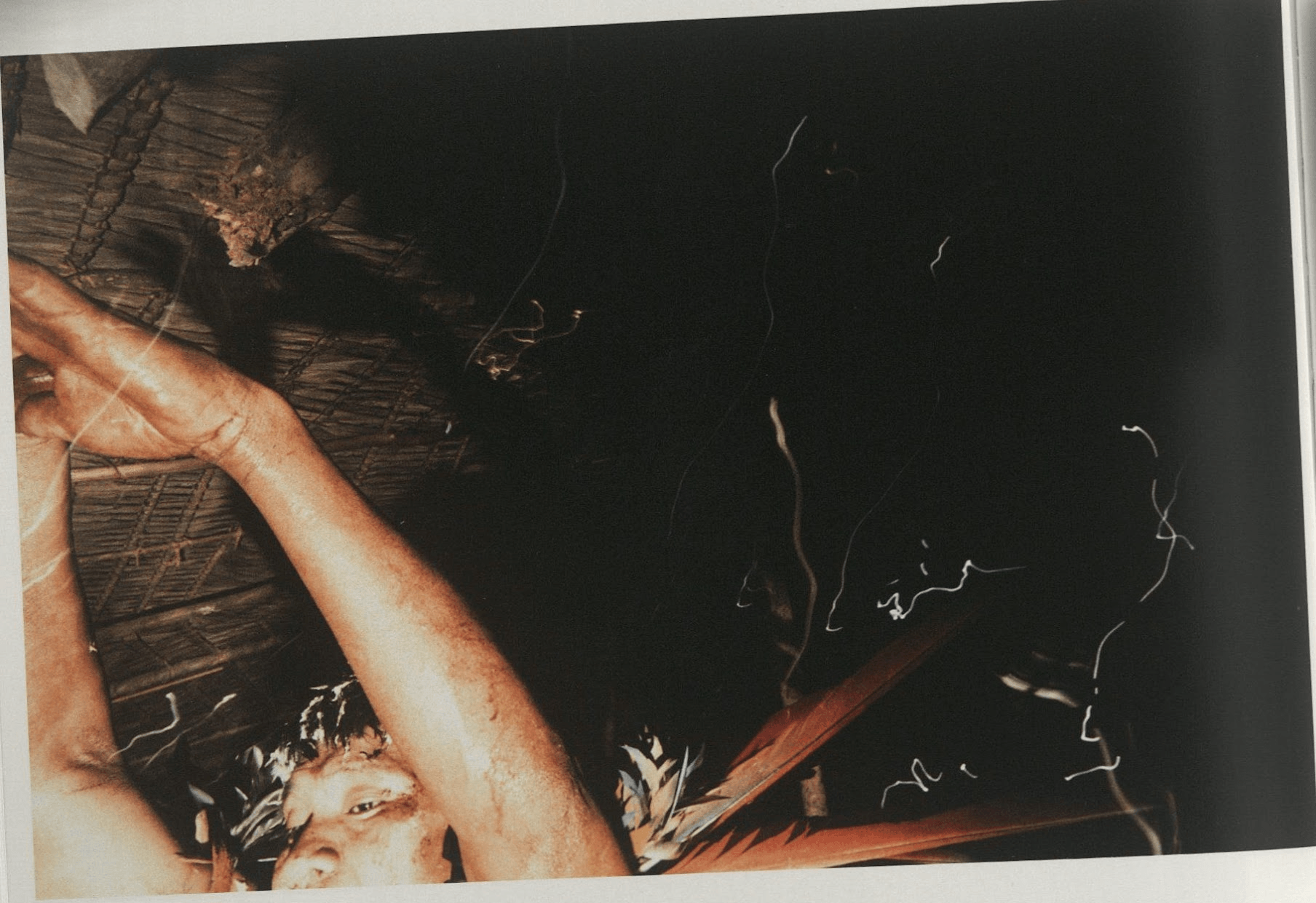
Andujar photographed the joyful singing of heri songs at night, the guest entering the collective house of their hosts (see fig. 3), their presentation dances, the trance-like effects of the excessive consumption of food, the hakimuu songs and dances of the young couples, the standing wayamuu dialogues, the squatting yãimuu ceremonial chanted dialogue (see fig. 4), and more. For Nogueira, these photographs of the reahu “represent one of the most important series of her work.” (Yanomami Struggle 195) This is, first, because, at that time, Andujar was more familiar with Yanomami culture than before; thus, she was able to visually interpret their culture with more depth. Second, and more importantly, because she now approached her photographs freed from the constraints of the photo-journalistic style and ethnographic gaze that was present in her earlier work. Evidence of this is her experimental and playful use of a variety of photographic techniques to capture the reahu—such as flashes, lamps, and lights; multiple exposures in a single photo; slow shutter speeds; applying Vaseline on the lens of the camera; shaking the camera at the moment of release; infrared film, wide-angle lenses, etc. Nogueira goes as far as to say that “Andujar transcends reality to capture the invisible, the abstract, and the immaterial.” (Yanomami Struggle 194) By this, I understand that he meant to say that, unlike journalist or anthropologist, whose aim, supposedly, is to capture the reality of the Yanomami, Andujar’s photography, by renouncing this ideal, was able to better capture some of the most intangible aspects of their culture, such as the shamanistic sessions at the reahu, or what I am calling their experience of hospitality.
I agree with Nogueira that Andujar’s photographs of the reahu show us something that is essentially different from what the anthropologist or journalist before her were able to capture. However, I push Nogueira’s logic to the limit, if possible, by means of Andujar’s own testimony and reflections on photography. In 1975, at the end of her grant, as she was retrospectively thinking about her experience, she wrote on the meaning of photography, and the difficulties of encountering the other by means of it:
Photography is the process of discovering the other and, through the other, oneself. Intrinsically, that is why the photographer seeks and discovers new worlds but in the end always shows what is inside himself. My search for the man/land interconnection was inside me before I went to the Amazon. And the treks through the forest only served as catalysts to reinforce what was basically there. (Andujar 101)
Claims such as this indicate that Andujar was aware of the limitations of photography to capture the reality of the other, in this case, the Yanomami. She also described a logic of hospitality to the other that goes beyond Nogueira’s interpretation. It is not only that the photographer must experiment with photographic techniques to capture the most elusive aspects of his or her subject. Rather, there is an essential limitation to the process of capturing the other in general. If I can only understand myself through the other, and in photographing the other I show what was inside me, then, what is it being shown: me or the other? To put it in another way, in looking at the photographs of the reahu, have we come to understand, let us say, the shamanism of the hosts, or have we come to understand Andujar’s experience, namely, that of the guest? Andujar wondered about these limitations of her photographic project.
There is a structural analogy between the paradox of photographing the other that Andujar recognized, and the aporias of hospitality formalized by Derrida. Hospitality cannot but limit itself by exercising itself: the host must affirm the laws of the house while welcoming the guest in its otherness, thus limiting the gift and hospitality offered. Likewise, Andujar’s experience of hospitality among the Yanomami cannot but be mediated by the camera (and other technical objects, such as videotapes). The camera receives or welcomes the other, but, in welcoming the other, it also captures it. Moreover, these photographic reception and capture of the other is conditioned or premised on the ipsiety of the photographer, namely, the presence of some kind of self-affirmation. This is what Andujar identified: the photographer “discovers new worlds” but, in doing so, “in the end,” she always discovers and shows herself. (101) Yet, without this self-affirmation, mastery, or sovereignty of the photographer, there would be no photographic reception of the other. This structure is not unique to photography, it occurs every time there is attentive perception or sensation of the other. Indeed, Andujar attempted to include the Yanomami in the production of their own culture by inviting them to draw their experiences and write poetry. These were published in 1978 in a book titled Mitopoemas Yãnomam.4 Similar to the case of political hospitality, the essential limitation of the hospitality of the photographer lies in the fact that the reception of the other is conditioned by the affirmation of the ipsiety, sovereignty, mastery, etc. of the photographer. Yet, an ethics of photography would call for a photography beyond mastery, or, at least, one that risks it or puts into play. Andujar’s photographs do not escape the aporias of hospitality or photography, but they do risk the self-mastery of the photographer (and the spectator), and the stability of the gaze.
The second series of photographs that exemplify the situation of hospitality at the limit in Andujar’s work are a series of black and white portraits of the Yanomami that she took during the same trip to the region of the Catrimani. These portraits were first published in 1978 in Andujar’s first book titled Yanomami: Frente ao eterno. According to Nogueira, “by utilizing only the natural light of collective houses, children, youths, and the old emerged from a dark background in varying planes,” and “each portrait used almost an entire film, the time necessary to build intimacy.” (Yanomami Struggle 197) Other than the variety of faces, the pictures also showed details of the body—such as the belly of a pregnant woman or the penis of a young man—and adornments—loincloths, earrings, perforations—details that were significant to photographer. Keep in mind that the intimacy that the portraits expressed had to be reached without the mediation of spoken language. As Andujar put it: “We made ourselves understood through gestures and mimicry. Answers were in the gaze. I wanted to observe, absorb, in order to recreate in the form of images what I was feeling. Perhaps dialogue might even interfere.” (101) Perhaps what Andujar meant to say is that even if they had spoken the same language, there is something about dialogue that interferes with the kind of reception of the other that she was interested in. At that time, she was not so much interested in understanding their culture (myths, cosmology, kinship structures, etc.), but wanted to recreate her experience—what she absorbed and felt—in a photographic medium. The silence of the camera allowed Andujar to receive the Yanomami beyond language, and “recreate in the form of images” this experience of hospitality. (101) A silent encounter can be evidence of a situation of hospitality at the limit, that is, one that does not require the foreigner to speak my own language, one that does not ask for a proper name, one in which the presence of the human face is sufficient to elicit a response from the spectator.
At the same time, Andujar’s portraits of the Yanomami stand in a problematic relationship to their customs, in particular, the portraits transgress the laws concerning proper mourning. As Albert explained, the Yanomami practice a form of “ritual erasure,” described by the expression õno ki wãriai, meaning “to destroy the marks/traces”: when someone dies the kin of the deceased collect everything he owned and that connected him to communal life—for example, the plants of his garden, the trees he recently climbed on, the bark of the post that supported his hammock, the soil he walked upon inside his house, or the leaves that covered his home—then these traces are destroyed during the lamentations of the reahu feast. (Kopenawa and Albert 550) On the last day of the reahu, the kin of the deceased carry out a funerary service in which they “put the ashes in oblivion” (uxi pë nëhë mohotiamãi), namely, they ingest or bury them. (Kopenawa and Albert 494) The latter follows after a special kind of squatting sung dialogue, which is itself an important part of the funerary ritual, and is described by the expression to “submit the funerary ashes to an exchange dialogue” (uxipë yãimumãi). (Kopenawa and Albert 498) Certainly, a portrait of a person would also have to be destroyed at the end of the reahu. When the portraits were taken, Andujar was ignorant of this practice, and the Yanomami were ignorant of the effects of the photographic camera. Today, Kopenawa, and the newer generations of Yanomami, tolerate the infringement of the rule given that Andujar’s photographs are used to foster the struggle and survival of their people.
So, here we have a couple of examples that mark the limits of the political interpretation of Andujar’s work. To make visible the struggle of the Yanomami people, and generate political traction in favor of their cause, the portraits (and other identification photographs, such as the ones exhibited in Genocídio do Yanomami) have to be preserved and made public. However, this already represents a failure to preserve Yanomami culture since it infringes on some of their most essential ritual practices. The infringement of the law is tolerated in the name of a higher necessity: not only to protect the lives of the remaining Yanomami people, but also to stop the destruction of the forest and the Earth. Likewise, Andujar’s own reflections, opened up the question of the extent to which her photographs—for example, the series of portraits or the reahu—have actually captured and publicized Yanomami culture, and their struggle. For example, have we come to better understand Yanomami shamanism and their funerary practices, or have we come to understand Andujar’s experience of foreignness and as a foreigner? It is not possible to provide an answer to these questions that will settle them once and for all. As Derrida demonstrated, hospitality carries within itself its own hostility. The aporias of hospitality are irreducible whether it is in respect to the welcoming of the other as foreigner in the realm of the political, or the reception and capture of the other in photography. Andujar’s photography calls for an interpretation beyond the exclusively political because it is inscribed in a situation of hospitality at the limit. It is impossible to receive the other without capturing it; or, in other words, the photographic reception of the other is conditioned by the self-mastery of the photographer. Likewise, with respect to Kopenawa, it is possible to problematize the political interpretation of his testimony by focusing on his experience of shamanism. In this case, it will be a question on the possibility of offering and receiving hospitality to and from the non-human others—the spirits or specters of the ancestors.
Yanomami Shamanism and the Arrival of the Other
On the last day of the reahu, before its culmination in the ritual erasure of the deceased, the Yanomami collectively partake in the consumption of yãkoana (see fig. 5). (Kopenawa and Albert 498) The yãkoana is a powder prepared by cooking, drying, and grinding the deep part of the bark of the yãkoana hi tree (Virola elongata). (Kopenawa and Albert 492) To consume it, shamans use a long tube, between fifty and ninety centimeters long, made from the hollowed-out stalk of a palm (horoma), to blow the snuff into each other’s nostrils. (Kopenawa and Albert 495) It contains a high concentration of dimethyltriptamine (DMT), which is a powerful hallucinogenic alkaloid. It also contains various ingredients that probably reinforce its effects, such as dried and pulverized maxara hana leaves, and the ashes of the ama hi and amatha hi tree barks. The effect of the yãkoana is described by the verb nomãi, meaning “to die.” (Kopenawa and Albert 498) It is so strong that most of the Yanomami who inhale it during the reahu fall into a “ghost state” (poremuu) of temporary unconsciousness. (Kopenawa and Albert 495) Andujar herself experienced the yãkoana outside the village in Boa Vista, and described its effect as divided in two parts: first, a momentary “highly unpleasant sensation” in which she thought she was “going to go crazy and felt like climbing the walls,” then, a second instance, in which she felt like “floating in the air, incorporeal, in a state of grace.” (Nogueira, Yanomami Struggle 196) Only the initiated have the necessary experience to act under its influence and conduct shamanic sessions (yãkoanamuu) without losing consciousness, or entering into a “ghost state.”
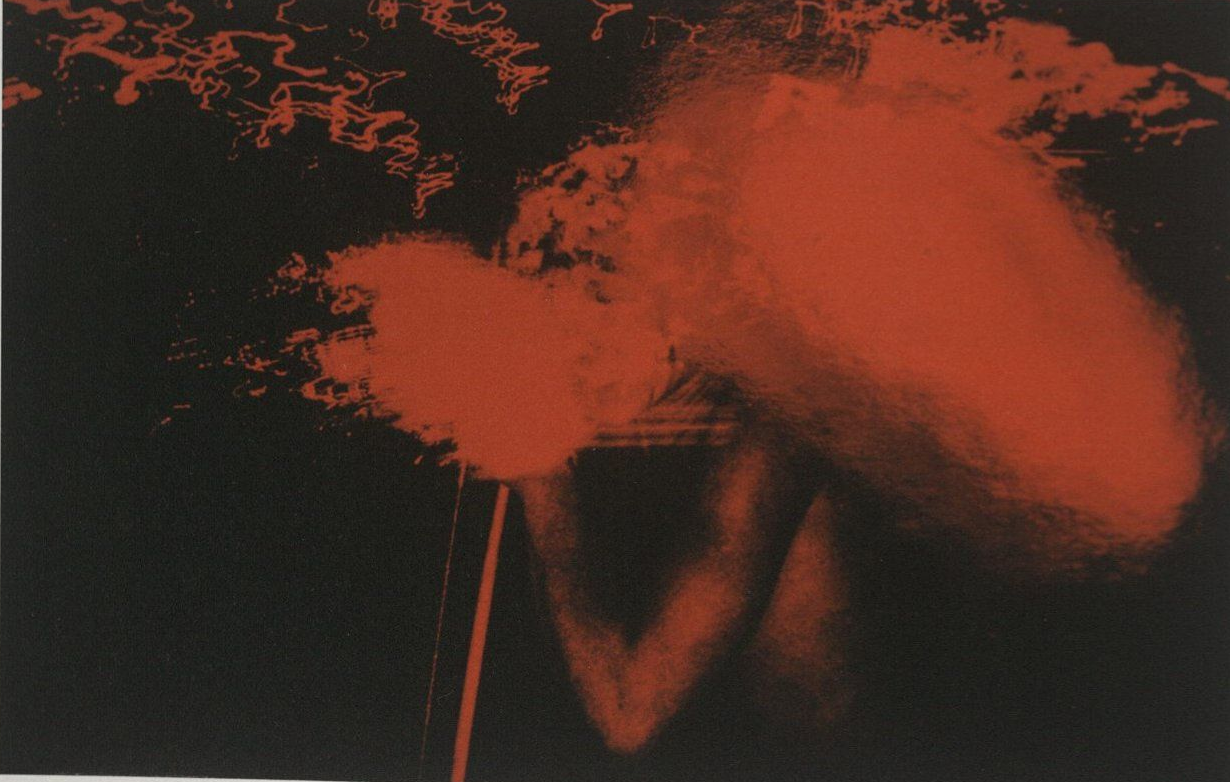
According to Albert, during these sessions, Yanomami shamans can “call,” “bring down,” and “make dance” the primordial “image” (utupë) of a determined existing being as an “auxiliary spirit” (xapiri, plur. xapiri pë) (see fig. 6). (Kopenawa and Albert 590) The term xapiri also refers to other related concepts such as the shamans themselves (xapiri the pë), and the practice of shamanism (xapirimuu). To become a shaman is also said “to become a spirit” (xapiripruu). The xapiri pë are part of a more generic category of “unknown and dangerous invisible entities” (yai thë pë) which also includes ghosts (pore pë), and the evil beings of the forest (në wãri pë), among others. (Kopenawa and Albert 496) The xapiri pë are mostly the images (utupë) of the human/animal ancestors (yarori pë) who lived in primordial times. (Kopenawa and Albert 496) However, the complete set of images that a shaman may invoke is highly heterogeneous and potentially infinite—it includes the forest spirits (urihinari pë) and water spirits (mãu unari pë), but also all the other entities of Yanomami cosmology, domestic animals, and objects—and even the spirits of the ancestors of white people and their animals (bull, horse, sheep, etc.) (Kopenawa and Albert 502)
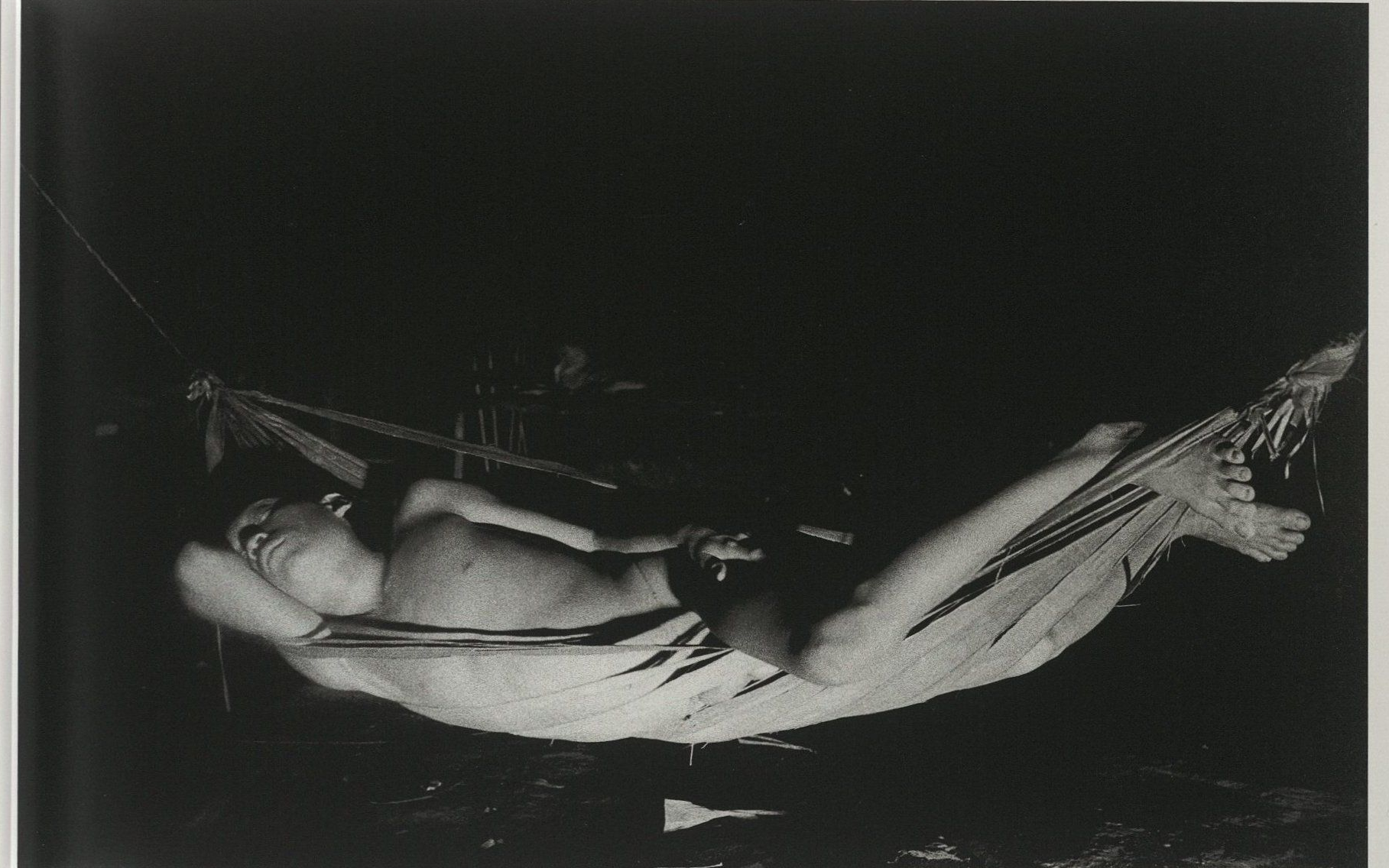
Conducting shamanistic sessions during the day by inhaling yãkoana snuff is not the only way in which the Yanomami encounter the xapiri; nocturnal shamanism associated with the time of dream (mahi) is an equally fundamental experience. (Kopenawa and Albert 496) During the time of dream (mahi), the xapiri take the shaman’s image (utupë) far away from his body (siki); it is then said to have the “dream value of spirits” (xapiri pë në mari). (Kopenawa and Albert 496) Kopenawa contrasted the dreams of shamans to those of non-shamans:
We are other people. When our eyes are dead with the yãkoana powder during the day, we sleep in a ghost state at night. Then, as soon as we doze off, the xapiri start to come down to us. […] Your body remains stretched out in its hammock, but your image and breath of life fly off with the spirits. The forest then recedes at great speed […] By drinking the yãkoana, we do not slumber in vain. We are always prompt to dream. Having become ghosts, we relentlessly roam distant lands while making friendship with their inhabitants’ xapiri. (Kopenawa and Albert 376)
Whenever a person that is not a shaman dreams, his image is not taken far away by the xapiri. In contrast, they usually dream about whatever happens in their day-to-day lives: their farms, game, family, or, if they are outsiders, with merchandise, money, etc. Inhaling yãkoana snuff, however, is not the only way to have the “spirits’ value of dream” (xapiri pë në mari): the xapiri pë also appear in the dreams of children—although in a less distinct way than to the older shamans (see fig. 7.) Indeed, the first time that Kopenawa encountered the xapiri was in his dreams. This occurred back in the late 1950s, when he was still a child living at his parent’s house, Marakana, in the upper Rio Tootobi. His calling was violently interrupted at that time by a series of epidemics that decimated his parent’s generation: first, one in c. 1959 introduced by the agents of the Indian Protection Service (SPI), then, a second one, in 1967 introduced by the daughter of one of the pastors of the New Tribes Mission.
Kopenawa’s descriptions of the xapiri are beautiful and complex. His testimony offers many threads for thinking. Some commentators, like the anthropologist Viveiros de Castro, emphasize the visual characteristics of the xapiri, “such as luminosity, a mirroring power, and microscopic size,” to argue that they are part of a coherent metaphysical system of explanation for the Yanomami. (Skafish 400) “In particular,” he writes, “I take Kopenawa’s discourse as expressing a pan-Amazonian conception in which the notions we translate as ‘spirit’ denote an ontological mode of the ‘intensive virtual multiplicity’ type.” (Viveiros de Castro 155) Similarly, Nogueira argued that Kopenawa’s descriptions of the xapiri offer a retrospective interpretation of the visual aspects of Andujar’s photographs. He writes: “Reflections, duplications, and other specular relationships are present in Andujar’s images. The multiple relation of the xapiri also relates to the nature of photographic reproduction, with an original that can be multiplied ad infinitum.” (Yanomami Struggle 194) The previous interpretations are certainly consistent with Kopenawa’s testimony, and, moreover, they capitalize on his own triangulation between utupë, xapiri, and photography: “Every being of the forest has an utupë image. These are the images the shamans call and bring down. These are the images that become xapiri and do their presentation dance for us. They are like photographs.” (Kopenawa and Albert 60) In the previous, Kopenawa set up an interesting analogy between the shamanic spirits and the photographs, and between the yãkoana and the camera. However, the non-visual aspects of Kopenawa’s testimony of the xapiri are essential to understand the experience of Yanomami hospitality beyond its conventional delimitation. Yanomami shamanism questions the anthropocentric notion of hospitality; in particular, one which attempts to restrict the notion of the foreigner to that of the human, as subject of rights. As Derrida writes, the attempt to restrict the experience of hospitality and being-foreign to their meanings inscribed in the Western family, civil society, nation-state, cosmopolitical right, etc., “would mark a sort of limit to the limit,” which “would also keep us from taking into account all the turbulence, semantic or pre- or ultra-semantic, that might upset or blur such limits.” (63) Kopenawa’s testimony runs counter to a certain philosophical tendency which wants to restrict the meaning of hospitality and foreigner to the language of law, politics, and their regime of visuality.
Kopenawa’s testimony of his initiation demonstrates the possibility of an experience of hospitality to and from the non-human other. This is because the xapiri arrive as guests who call the shaman. The xapiri speak. The auditory is an essential aspect of the experience of hospitality offered by the Yanomami shamans to the xapiri. It is only after a long and arduous process of initiation that young Yanomami prospects become authentic shamans. During the initiation, which might last for days, the prospects must observe a series of strict prohibitions regarding eating, socialization, and others. In 1983, when Kopenawa was 27 years old, his father-in-law, Lourival, initiated him into shamanism. Kopenawa narrated, how, after multiple days being unconscious, in a “ghost state,” he finally was able to encounter the xapiri:
My very flesh had become that of a ghost. But before I could see the spirits, I first did my best to hear their words. I tried to imitate their songs little by little, as my father-in-law had recommended. He was the one who started to teach them to me. He introduced me to the xapiri as our ancestors have always done with their sons and sons-in-law. Then, as my attention focused, the spirit’s words began to be audible to me. They replaced my tongue and throat with their own. Piece by piece, their songs were revealed to me and each time they became clearer. I began to sing like them. But it came slowly. (Kopenawa and Albert 89)
The first thing that he experienced during his initiation was not the images of the xapiri, but their voices, in the form of songs and exhortations. It is only through the gift of the songs of his mentor that Kopenawa was able to distinguish the xapiri’s voices. There is an element of imitation involved in the process which is also a response. As Kopenawa would also say, the xapiri become happy if you imitate their calling songs, and hostile if you ignore them. Finally, there is also an element of substitution that is interesting. The apprentice must “die,” and become a xapiri himself to receive them, and, eventually, to be granted hospitality by them when traveling to far away lands during the time of dream—this happens through an experience of the dismemberment of the body of the shaman, and the substitution of its body parts for those of the xapiri, such as the tongue and throat.
Second, Kopenawa described the xapiri in terms of guests arriving to a reahu feast. In the beginning, they will build their spirit house in the chest of the young apprentice. They enter the shaman’s body to do their presentation dance, then settle down in their new sprits’ house.
Finally, the xapiri gather around the initiate’s new spirits’ house and one by one they enter through the door their path leads to, as the guests at a reahu feast would. Then they begin their presentation dance on the central plaza’s vast mirror, moving very slowly. Each one dances and sings in his own way. They are adorned like guests, their bodies covered in reddish orange paint and decorated with black drawings, their armbands heavily loaded with scarlet macaw tail feathers and their hair covered in bright white down feathers. They dance in a radiant light, gracefully waving frayed young palm leaves of bright yellow. They take turns bursting into melodious songs, never stopping. They eagerly blow into their thin bamboo flutes and let out cries of joy. The powerful rhythm of their steps strikes the ground with a dull thud. In the tumult and sparkling light, their annatto dye releases its heady scent. Then suddenly silence returns. (Kopenawa and Albert 101)
Kopenawa’s testimony blurs the semantic limit that encircles the meaning of hospitality and the foreigner within a purely anthropocentric determination. We understand that the xapiri are not primarily a “what,” or a thing, but they are closer to a “who” or a guest. The yãkoana itself, for example, is their “food” which the shaman provides for them. The shaman inhales, or “eats,” the yãkoana to give it to the xapiri who now live in his chest, and to feed those new and unknown xapiri who will arrive at another time. It is not so much the content or meaning of their songs that is essential, but that they call and respond to the shaman. The xapiri’s voices are primarily those of the ancestors, which are both human and animal—although, as we have seen, experienced Yanomami shamans can go as far as to receive and listen to the spirit of the forest, and of the Earth as a whole. This is precisely how the prophecy of the falling sky came about. It is then a form of memory, and dreaming, that ordinary Yanomami, and, all the more so, white people and other outsiders have no experience of. The pollution, in the air, sound, water, etc., the busyness of the cities, and the unmeasured desire for merchandise clogs dreams and memories of the outsiders. Yet, as Kopenawa points out, there are xapiri ancestors in the lands of the outsiders. Can “we” listen to them? In this case, “we” are all of “us” with “ghost eyes,” who are not shamans and cannot dream. Andujar’s photography is a key to opening the door to a different regime of hospitality, which also includes a different relation to imagination and visuality. Kopenawa’s testimony helps us put into relief the hallucinatory potential of photography; at the same time, Andujar’s photography brings into relief the paradoxes in which the representations of the other are entangled.
To conclude, in this essay I have narrated a history of developmentalism, extractivism, and genocide in the Amazon, and considered how both Kopenawa and Andujar fought to resist it, principally through the official designation of Yanomami territory as protected indigenous land. Then, I tried to point out the aspects of their work which mark and problematize the limits of the political, namely, those that situate them in a situation of hospitality at the limit. Read in company with Derrida, Andujar’s photographs of the reahu and the portraits taken during her trip to the Catrimani region mark the paradoxes of photographic representation and the inevitable transgressions of the laws of hospitality. Likewise, an analysis of the non-visual aspects of Yanomami shamanism, and, in particular, Kopenawa’s testimony of his initiation, demonstrated the blurring of limits of the meanings of hospitality and the foreigner beyond anthropocentrism.
Notes
- Cf. Galeria | Claudia Andujar “A última chance dos últimos guerreiros” Reportagem para o número especial “Amazônia” da revista Realidade. Fotografias e Trajetórias, 4 Nov. 2026, https://sites.usp.br/fotografias/claudia-andujar/numero-especial-da-revista-realidade-dedicado-a-amazonia/. ↩︎
- Cf. Povo da lua, povo da sangue. Directed by Marcello Tassara, 1984. Vimeo, 4 Nov. 2026, https://vimeo.com/201569402. ↩︎
- Cf. Claudia andujar. Genocídio do Yanomami: morte do Brasil, 1989, impressão em 2021. Museu de Arte de São Paulo, 4 Nov. 2026, https://masp.org.br/acervo/obra/genocidio-do-yanomami-morte-do-brasil. ↩︎
- Cf. Andujar, Claudia. Mitopoemas Yãnomam. Olivetti do Brasil S.A., 1978. International Center for the Arts of the Americas at the Museum of Fine Arts, Houston, 4 Nov. 2026, https://icaa.mfah.org/s/en/item/1110746. ↩︎
Works Cited
- Andujar, Claudia. “Relationship: Man to Man.” Claudia Andujar, The Yanomami Struggle, edited by Thyago Nogueira, with Instituto Moreira Salles, Fondation Cartier pour l’art contemporain, 2020, pp. 99–101.
- Bonchristiano, Patricia A. “Claudia Andujar and the Yanomami: Photography and Activism in the Changing Light of the Amazon Forest.” Journal of Latin American Cultural Studies, vol. 33, no. 4, Oct. 2024, pp. 569–95. DOI.org (Crossref), https://doi.org/10.1080/13569325.2024.2431005.
- Derrida, Jacques. Hospitality, Volume I. Edited by Pascale-Anne Brault and Peggy Kamuf, Translated by E. S. Burt, University of Chicago Press, 2023. Originally published by Éditions du Seuil, 2021, The Seminars of Jacques Derrida. DOI.org (Crossref), https://doi.org/10.7208/chicago/9780226828022.001.0001.
- Kant, Immanuel. Toward Perpetual Peace and Other Writings on Politics, Peace, and History. Edited by Pauline Kleingeld, Translated by David L. Colclasure, Yale University Press, 2006. Rethinking the Western Tradition.
- Kopenawa, Davi, and Bruce Albert. The Falling Sky: Words of a Yanomami Shaman. Translated by Nicholas Elliott and Alison Dundy, The Belknap Press of Harvard University Press, 2013.
- Nogueira, Thyago. “Claudia Andujar: In Conversation with Thyago Nogueira.” Aperture, no. 215, 2014, pp. 116–27.
- Nogueira, Thyago, editor. Claudia Andujar, The Yanomami Struggle. With Instituto Moreira Salles, Fondation Cartier pour l’art contemporain, 2020.
- Schefer, Raquel. “Making the Xapiri Dance: Photography and Shamanism in the Exhibition Claudia Andujar, The Yanomami Struggle.” NECSUS: European Journal of Media Studies, vol. 9, no. 2, June 2020, pp. 339–50. DOI.org (Datacite), https://doi.org/10.25969/MEDIAREP/14322.
- Skafish, Peter. “The Metaphysics of Extra-Moderns. On the Decolonization of Thought— a Conversation with Eduardo Viveiros de Castro.” Common Knowledge, vol. 22, no. 3, Sept. 2016, pp. 393–414. DOI.org (Crossref), https://doi.org/10.1215/0961754X-3622248.
- Viveiros de Castro, Eduardo. “The Crystal Forest: Notes on the Ontology of Amazonian Spirits.” Inner Asia, vol. 19, no. 2, pp. 153–72.