
Daniel Runnels
Texas A&M University
Volume 18, 2026
In After Fukushima: The Equivalence of Catastrophes, Jean-Luc Nancy argues that modern catastrophes should no longer be understood simply as isolated events but rather as the results of interconnected systems that link multiple and varied spheres of life: politics, technology, economics, and more. Calling into question the distinction between “nonproduced forces (the ones we used to call ‘natural,’ like wind and muscle) with produced forces (steam, electricity, the atom),” Nancy writes that “we have entered into a general configuration where the forces of production of other forces and the other forces of production or action share a close symbiosis…” (26). It is this symbiosis that, in his view, “makes [the 2011 nuclear disaster at] Fukushima exemplary.” What Fukushima shows, for Nancy, is that “there are no more natural catastrophes: there is only a civilizational catastrophe that expands every time” (34). While the term “anthropocene” does not appear in Nancy’s text, his reflections on the singular event of the Fukushima nuclear disaster therefore speaks to the global interconnectedness of the contemporary world, as well as the ideas that humanity is now a geological force and that technology and nature are no longer separate. This is a helpful frame for considering some of what is at stake in Fever Dream, the film adaptation of Samanta Schweblin’s 2014 novel, Distancia de rescate.
Fever Dream is the story of a mother and daughter, Amanda and Nina (Figure 1), who travel to a quiet rural town in the Argentine interior with the goal of spending the summer away from city life. There they meet another family, Carola and her son David, whose relationship is strained as a result of an accident David suffered: his exposure to an invisible ecological tragedy, the pesticides that pulse through the river near the small town. The title refers to the story’s most important theme: the distance that mother Amanda leaves between herself and her daughter Nina, a distance she constantly measures to ensure she can rescue her daughter in a scenario of potential danger. Like other works by Samanta Schweblin – the author of the novel that the film is based on – this story abounds in tension not only between the characters but also between human beings and the so-called “natural” world. The fact that nature becomes a source of horror that leads to death allows us to think of this film as a meditation on the Anthropocene, something several other critics have done. Gareth Williams writes that the novel Distancia de rescate indexes what he calls “the epochal anxiety” facing humanity in the times of the Anthropocene; Nicolás Campisi highlights the Gothic aesthetic as the story’s characters face an invisible and omnipresent danger; Leila Lehnen has commented on the novel as an “allegory of the penetration of biocapitalism not only in the Argentine countryside, but also in the bodies of its citizens” (28). I, however, want to highlight two elements of the story that have not yet received much attention: flight and the status of children in the story.
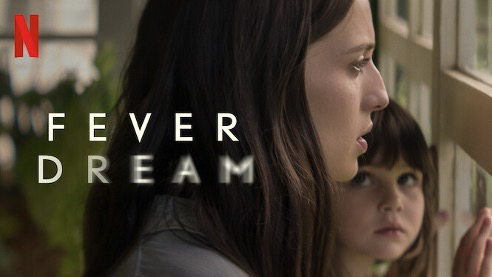
An initial claim: this is a film about flight, or rather, about the impossibility of flight. The narrative driving force of the story arises from Amanda and Nina’s decision to flee the frenetic pace of the city to spend a quieter and more relaxing summer in the Argentine countryside. We are constantly reminded of Amanda and Nina’s status as outsiders in the community: there are things they don’t know, experiences they haven’t had, different ways of seeing the world. They lack local knowledge both about social life (the fact that the town doctors are unreliable and come infrequently, necessitating multiple visits to la casa verde) and about the natural world around them (the invisible dangers that await them everywhere). In fact, it is this lack of local knowledge that attracts Amanda. The entire trip is meant to be an escape: an escape from the city, an escape from time (part of the impetus for the trip is for both Amanda and Nina to experience a place her father always told her about—a nostalgic longing, the desire to recapture something from the past that cannot be recaptured), and an escape from capitalist modernity. Once they arrive in the town and settle in, Amanda becomes fascinated by Carola, a woman who is from the small town but has a certain cosmopolitan air about her. Carola’s figure is, for Amanda, the first indication that the city/country binary that has long governed the Argentine national psyche has broken down. Carola is an ambivalent object of desire for Amanda – simultaneously an object of fascination and repulsion (Figure 2). Amanda becomes obsessed with Carola’s gold bikini, her elegant jewelry, and her self-proclaimed interest in injecting her small town with a little bit of “glamour,” but at the same time she becomes very angry with her for the way she treats her son David. In the figure of her new friend Carola, Amanda finds ambivalence; there’s something appealing about this person and this place, even though what is appealing bears an uncanny resemblance to elements of her life in the city.

But while the relationship with Carola is formative in this story, what is most important is what nature represents for Amanda and Nina in their attempt to escape. In Fever Dream, nature does not serve (or indeed cannot serve) as the refuge from urban life that Amanda wanted. Here, nature has been completely subsumed into the capitalist web of relations. Flight to nature is then impossible, or if possible, at least it offers no escape from the capitalist system because, as the film shows, global networks of food production and distribution have turned nature not into an idyllic and peaceful place of refuge, but rather, here, nature can kill you. The distinction between nature and culture has given rise to numerous narratives that recount nature’s potential to devour human life, stories that very often focus on nature as a distinct entity that represents a danger different from anything generated in the human world of society and culture. Other narratives that accept the nature/culture distinction position nature as a potential respite, an idyllic and safe place to which one can escape. This is the vision of nature under which Amanda operates, but while she herself has a vision of the natural world that privileges its potential for escape, the film offers a different vision. Rather than escape, here it is a matter of further incorporation into.
This is a phenomenon evident in numerous works of Latin American nature writing, but also one that has found expression in other contexts. This collapse of the real distinction between city/country, urban/rural, capitalist center/non-capitalist periphery has been theorized under various names; Empire is perhaps the most common, but in this case “metropolis” is more appropriate. The various theorizations of the metropolis refer not to the way the term is use in common usage – a densely populated geography of a modern city that serves as an economic, cultural, and political motor for a national or regional community – but rather as the non-differentiated space of the 21st century world on a planetary scale. For example, in Il ghiaccio era sottile. Per una storia dell’Autonomia, Marcello Tarì defines the metropolis as a stage of history in which the logics of capitalist production are diffused throughout the entirety of social life, one where what was once confined to the walls of a factory have come to characterize global social relations. This line of reasoning is picked up by The Invisible Committee in their well-known text The Coming Insurrection. Here, they wholly dismiss “the supposed ancient opposition between [the city and the country],” arguing instead that “what surrounds us…is one single urban cloth, without form or order…Everything occupies the same space, if not geographically then through the intermeshing of its networks” (52). “Metropolis” has also been theorized by the anonymous Mexican collective Consejo nocturno in their text Un habitar más fuerte que la metrópoli where they argue that our response to the metropolis should be to shift our relationship to the planet from one of governing to dwelling. Theorizing the world as a metropolis does not mean that difference is annulled; it is not a matter of ignoring or flattening the local specificities of cultures and communities in the globalized world, in capitalism, or in the Anthropocene. Rather, at stake is the notion that there is no critical vantage point into which one can escape. The local still matters, but it is always already captured by the metropolis.
Fever Dream follows this logic because here nature is not separate; it is completely subsumed into the global capitalist system, a scenario that has given rise to a new phenomenon: here nature can kill you not because it is so different from the world of human culture, but precisely because it has been completely integrated into it. Agrotoxins lurk in every corner of both the small town and the forest that surrounds it. These agrotoxins cause David and Amanda’s illnesses, and cause the numerous deformities of the animals in the village. They are also the reason why many (or all) of the town’s children suffer from various physical and social problems. As David tells Amanda near the end of the film, “acá son pocos los niños que nacen bien” (108). The danger is both invisible and omnipresent. While Amanda and Nina think they are fleeing to something far from the network of capitalist modernity, they are actually drawn deeper into this net, and in a way that represents a more immediate and fatal danger.
It is for this reason that the film’s primary, operative metaphor is so important: the distancia de rescate, a metaphor that is subjugated to illness in English-language translations of the title – Fever Dream. For Amanda, la distancia de rescate is an invisible thread that binds her to her daughter, Nina. This thread represents the physical distance between the two, a distance that Amanda calculates at all times, taking care that the distance is not so great that she cannot save Nina should danger arise. As Gareth Williams has noted, “The distancia de rescate suggests an instinctive faith in human calculability, and therefore in the existence of a world that can always be subjected, modified, and improved for the benefit of human dominance and spatial-temporal control” (27). Faced with the dangers of a world in which everything—including nature—has become a standing reserve, Amanda responds with her own calculability, in this case a calculability based not on the capitalist drive for continuous accumulation, but rather on a familial, mother-daughter relationship. But as we know from the opening scene of the film, it is already too late. Amanda is ill. She is dying, and Nina is not with her: the distancia de rescate has failed.
Later in the story the theme of flight is further emphasized, though this time in a different direction. Once Amanda realizes that they haven’t really escaped into anything different, she wants to escape again, this time back to the comforts of her other life. Her desire to return to the city in search of the comforts of her other life is due, in part, to her internalization of the fear of David that Carola exhibits throughout basically the entire film, a danger that adds to the other dangers they have encountered. When they try to flee to a space outside, it turns out they have only two options. What they can do is either try to return—to escape again, an act which would mean they have not been able to flee anything at all—or die there.
But if on the one hand this is a film about the impossibility of escape, it is also a film about children. This is an aspect that has so far been little discussed in existing criticism. There are a couple of minor exceptions. Nicolás Campisi, for example, in his book The Return of the Contemporary comments that Schweblin’s novel is “not about agricultural work, but about the labor of raising children in extreme ecological conditions” (175). I want to put more emphasis on the children and what they represent. If children represent anything, it is precisely the future, the new world, the continuation of the human species, however uncertain it may be. Fever Dream is deeply pessimistic about this.
In this way, village life represents an internal division within the anthropos, giving voice to a reason why many resist the term Anthropocene. The criticism of the term Anthropocene is that it lumps humanity into a single group as a cause without recognizing the difference between those who cause the problem the most and those who cause it the least. Fever Dream reflects on this question in one way, but from a different perspective. The film singles out the town’s children as those who suffer the most from the consequences without having contributed to the ways of life that have led to the current state of the planet. On this issue, the story is not subtle; the town’s children suffer physical deformities and a series of social problems that are explicitly attributed to the ubiquity of agrochemicals in the soybean fields surrounding the town. According to Fever Dream’s logic, if we wanted to add another term to the long list of words proposed as alternatives to the Anthropocene—capitalocene, chthulucene, technocene, anthrobscene, among others—something like “generation-cene” would not be inappropriate, an era characterized precisely by stealing the future from younger generations, from children. The internal rupture of the anthropos would be a generational rupture here, and not necessarily one based solely on economic or other factors.
There are defenses to be made for the term “anthropocene” however. Claire Colebrook, in her book Who Would You Kill to Save the World?, defends the term Anthropocene precisely because of the narrative violence it perpetrates: “the notion of a single humanity does not occur late in the day, after the advent of geological change, but is essential to the forms of self-narration that justified colonization, empire, and industrialization” (79). In other words, the term Anthropocene maintains an internal tension and names this tension in the term itself – the fault is not that of all humanity, but the decisions that have led us to this situation have been made as if they were made on behalf of everyone, even children. For the children of Fever Dream, the lack of a future is foisted upon them – the future is emptied, cancelled, annulled.
On this point, one does not have to squint very hard to see something more than a little bit resonant with Lee Edelman’s 2004 book No Future: Queer Theory and the Death Drive. In No Future, Edelman observes that the Child is the “perpetual horizon of every acknowledged politics” (3), a politics that “remains, at its core, conservative insofar as it works to affirm a structure, to authenticate social order, which it then intends to transmit to the future in the form of its inner Child” (2). The question he asks, then, is “What…would it signify not to be ‘fighting’ for the children?” (3). Or to put it another way, could there be a politics of the death drive? Edelman posits queerness as the name for the side that takes up this position – “the side outside the consensus by which all politics confirms the absolute value of reproductive futurism” (3). This would not be a fixed position that attempts to affirm any substantive identity, but rather one that can only ever disturb, a position that, for Edelman, is linked closely to “the remainder of the [Lacanian] Real internal to the symbolic order” (25). For Edelman, this queer negativity embraces the charge of asociality ascribed to it by those who promote humanist versions of progress that are based – whether they can admit it or not – on the positive futurity embodied in the figure of the child.
I want to broadly accept the claims at the heart of Edelman’s No Future, but extend them in a slightly different direction. Already in 2004 when Edelman published this book, the writing was on the wall regarding the coming ecological catastrophe, but now more than 20 years later the horizon of politics is marked increasingly by the threat of the Anthropocene. As it regards children, this horizon has led some to veer in the direction of a neo-Malthusian position on over-population, for example Italian philosopher Franco “Bifo” Berardi who has recently suggested anti-natalism as a sort of political act of resistance against capitalist psychosis.
This is not a position that Fever Dream takes. While Berardi advocates for anti-natalism as a conscious, agentic political strike against capitalist psychosis, Fever Dream presents a far more visceral and non-consensual predicament. The film does not suggest a willful refusal to reproduce; rather, the town’s poisoned children—who are already born—become the site of pure disruption from within the system. The children themselves approximate something like the queer negativity that Edelman posits. What I am suggesting is therefore a sort of step to the side of Edelman’s proposal. Edelman coins the term “sinthomosexual” to describe a position that embraces queer negativity, a subject not invested in reproductive sex and, therefore, not operating within the confines of acknowledged politics; in other words, a position which enjoys the death drive. In Fever Dream, I am not thinking about child sexuality or anything of the sort, but I am thinking about the children as figures of pure disruption in the same way that Edelman says that “queerness can never define an identity, it can only ever disturb one” (17). Because of the anthropocentric incursion into every corner of the Argentine countryside, the children of this town have been thrust into a position that can only be a disruption. They are unable to be smoothly incorporated into the existing symbolic order, they make their presence known solely as an irruption of the Real, not entirely unlike how Julia Kristeva emphasizes the insistent materiality of death when she describes the abject as an irruption of the Lacanian Real.
Let me offer three examples. First: David is Carola’s son, the character whose illness as a result of the agrotoxins present in the town creek sets the story’s main conflict into motion. He is nothing but a figure of disruption. When Amanda and Nina enter town on day one of their vacation, the vision of David lying motionless in a nearby rowboat distracts Amanda from what has otherwise been a pleasant trip; David is the first sign that something might be off about this town. When Amanda sees him, her gaze momentarily pauses, and we later accompany her on her journey to accept that something is off with David: he is not ok. In this opening scene we get a glimpse of David’s capacity to disrupt the normal unfolding of social life, but there are others. David is also the main focal point of the rift between Amanda and Carola. Again, Carola is an ambivalent object of desire for Amanda, but David intervenes here because of the strangeness of his behavior, behavior induced by the illness he suffers after being exposed to agrotoxins. This is punctuated visually in a decisive moment of the film, the first moment when Amanda angrily confronts Carola (Figure 3). At this important moment of the story, the camera’s view places David precisely in between Amanda and Carola, positioning him as a barrier, a disruption.

A second example: Midway through the film there is a moment when Amanda is abruptly woken up by a nightmare. She dreams something that we later understand to be foreshadowing, the specter of David’s soul migrating partially to the body of Nina, her daughter. Again it is the insistence on the materiality of death that, in this case, disrupts Amanda’s unconscious. If we follow the psychoanalytic path, this could be understood as wish-fulfillment, however not wish-fulfillment operating under the pleasure principle that was Freud’s guiding concept when he wrote The Interpretation of Dreams in 1899, but rather wish-fulfillment under the influence of the death drive that he discovered in 1920 in Beyond the Pleasure Principle. While Freud never returned to the topic of dreams in an explicit way after discovering the death drive, wish-fulfillment in the wake of Beyond the Pleasure Principle would almost certainly have had something to say about that most common of dream experiences, the nightmare, precisely what Amanda is interrupted by with the figure of her own child. In this framework, Amanda’s nightmare functions as a psychic manifestation of the failing distancia de rescate where the protective maternal bond is abruptly interrupted by the ecological horror she sought to flee.
A third example: Near the end of the film, after Amanda has made the decision to attempt to flee the small town and return to her life in the city, her exit is abruptly interrupted by a literal parade of children in the night. This time, it is not a dream; she slams the brakes of her car in order to keep from hitting several children who are crossing the street (Figure 4), all of whom exhibit some sort of physical abnormality, including a young girl she had previously seen at a store in town.
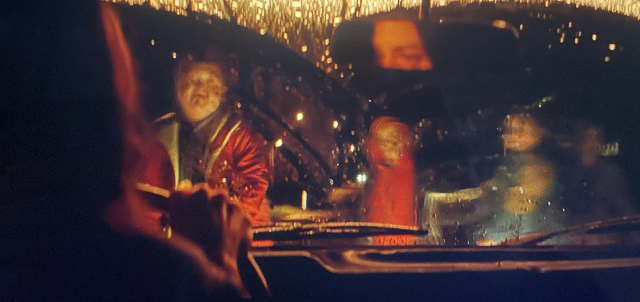
The town’s children as forces of disruption have, therefore, been present at every step of the way. From the moment Amanda and Nina rolled into town to their attempt to flee out of fear, these children – children who could reasonably be described as zombies, life infected with death – these children allow for no respite, no peace, no escape from physical danger nor its social repercussions. To borrow a phrase from Claire Colebrook in her book Death of the Posthuman, the children are “an allegory for humanity gone awry” (206). As pure figures of disruption – of the insistence of death in life – the children here embody what Edelman describes as “a refusal of the coercive belief in the paramount value of futurity, while refusing as well any backdoor hope for dialectical access to meaning…” (6). They uproot the grounds upon which the symbolic order purports to rest – faith in the future, in the self assurance of a politics that aims to extend its self-sameness beyond itself. In other words, children here cause an absolute break between a political ground and any attempt for this political ground to extend itself.
What we are left with, then, is a deeply pessimistic take on the situation in which humanity finds itself in the Anthropocene epoch. This film is not invested in anything like a prescriptive pathway out, nor a redemption story by which some segment of our human community could identify a politics to latch onto. This is a film where no escape is possible, the characters being led to a situation where the only semi-possible decision to be made is between an ever-frustrated attempt to flee and certain death – in other words the fact that there is no possible salvation through physical space. It is also a film where the future is annulled; the figure of the child is nothing more than a queer negativity that cancels any potential redemptive impulse. In both the spatial and temporal orders, this film is not interested in getting us to assume a normative position or take any sort of action. The film is more interested in showing us that, because of our reduction of everything to standing reserve which has led us to a situation that lacks both an escape route and a future, to borrow a phrase from Steven Swarbrick and Jean-Thomas Tremblay, we have made “unwitting sinthomosexuals of us all” (129). And it is on this point that the film makes its most powerful diagnosis. Unlike the Fukushima disaster that Nancy comments on, the Anthropocene catastrophe is not and cannot be reduced to a singular moment; it is a persistent and pervasive condition. Its true horror lies in the fact that it is not an event, but rather part of the fabric of the world.
Works Cited
Campisi, Nicolás. The Return of the Contemporary: The Latin American Novel in the End Times. University of Pittsburgh Press, 2024.
Colebrook, Claire. Death of the Posthuman: Essays on Extinction, Vol. 1. Open Humanities Press, 2014.
—. Who Would You Kill to Save the World?. University of Nebraska Press, 2023.
Edelman, Lee. No Future: Queer Theory and the Death Drive. Duke University Press, 2004.
Lehnen, Leila. “Planet Earth Strikes Back: Landscapes of Toxicity in Latin American Fiction.” Journal of Foreign Languages and Cultures, vol. 5, no. 2, 2021, pp. 22-32.
Nancy, Jean-Luc. After Fukushima: The Equivalence of Catastrophes. Fordham University Press, 2015.
The Invisible Committee. The Coming Insurrection. Semiotexte, 2009.
Tremblay, Jean-Thomas and Steven Swarbrick. Negative Life: The Cinema of Extinction. Northwestern University Press, 2024.
Williams, Gareth. “Anthropocene, Infrapolitics, and Ephocal Anxiety: Upon Reading Samanta Schweblin’s Kentuckis and Distancia de rescate.” Culture Machine: Journal of Culture and Theory, vol. 22, 2023, pp 1-38.